
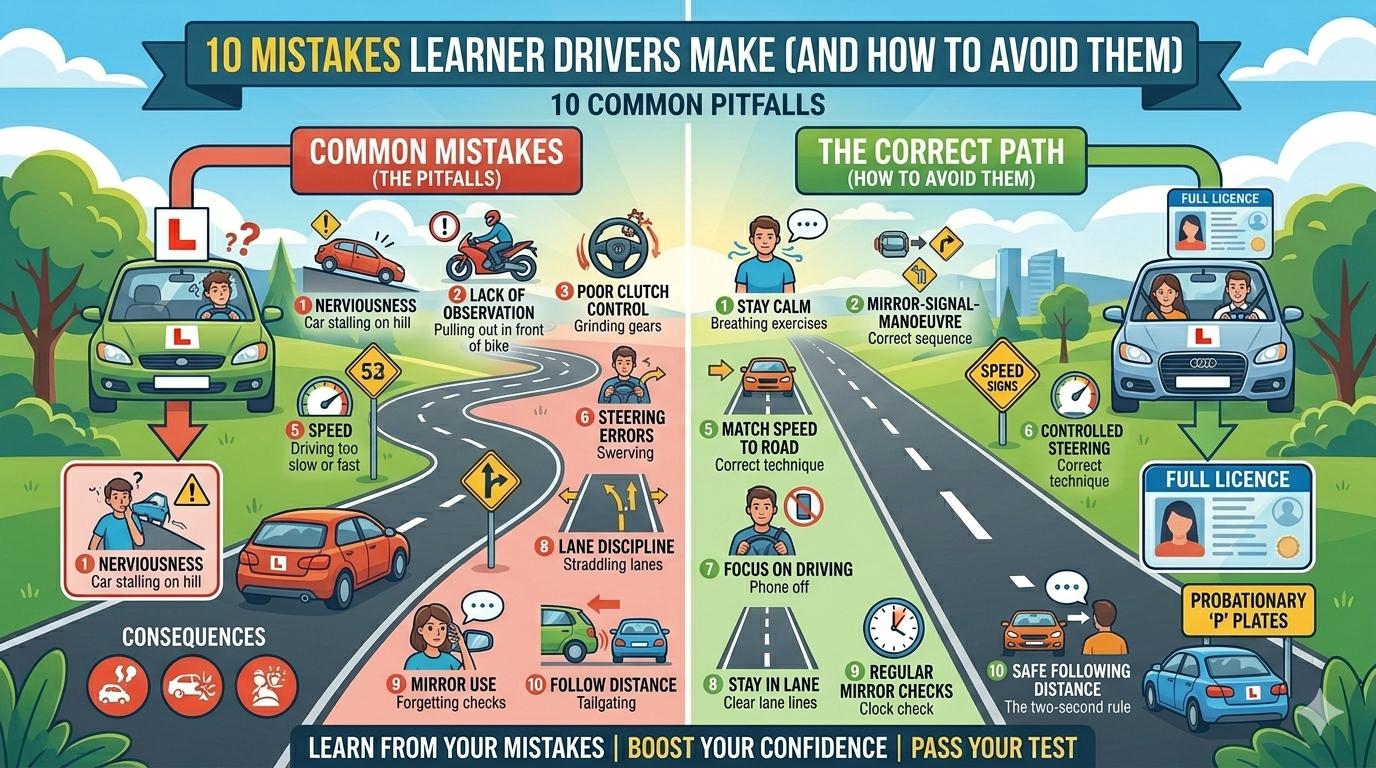
Learning to drive is one of the most exciting milestones of your life — but it can also feel overwhelming. Even the most enthusiastic learners fall into the same traps. Whether you’ve just booked your first lesson or you’re approaching your test date, knowing what to watch out for can make all the difference.
Here are the 10 most common mistakes learner drivers make in the UK — and, more importantly, exactly how to avoid them.
1. Not Checking Mirrors Often Enough
The DVSA expects you to use your mirrors constantly — not just when you’re pulling out or changing lanes. Many learners forget to check mirrors during routine driving, costing them serious faults on their test.
How to avoid it:
Practise the MSM routine (Mirror–Signal–Manoeuvre) until it becomes second nature. Check your interior mirror every 5–8 seconds as a general rule, and always before braking, signalling, or changing speed.
2. Incorrect Use of the Clutch (Manual Drivers)
Riding the clutch — keeping your foot partially depressed — is one of the most damaging habits a learner can develop. It causes excessive wear and makes smooth driving virtually impossible.
How to avoid it:
Once you’ve found the biting point and the car is moving, bring the clutch up smoothly and completely. Rest your foot flat on the floor, not hovering over the pedal. Your instructor will help you feel the difference.
3. Poor Observation at Junctions
Emerging from a junction without adequate observation is one of the most common reasons learners fail their practical test. It’s also a genuine safety risk.
How to avoid it:
Always approach junctions at a controlled speed. Take effective, deliberate looks left, right, and left again before emerging. If in doubt — don’t go. Hesitation is far safer than rushing.
4. Stalling the Car
Stalling is embarrassing, but it’s also extremely common. It usually happens at junctions, roundabouts, or when moving off on a hill. A stall in the wrong place can cause a serious fault on your test.
How to avoid it:
Concentrate on finding the biting point before releasing the handbrake. If you feel the car judder, gently press the clutch back down and start again. The more you practise moving off, the more natural it becomes.
5. Driving Too Slowly
Many learners assume that slow driving is always safe. In reality, driving unnecessarily slowly — especially on A-roads and dual carriageways — creates hazards and is a driveable or serious fault in a test.
How to avoid it:
Always match your speed to the road and conditions. On a national speed limit road with no hazards, you should be comfortable driving at or near 60mph. Trust your training and build confidence progressively with your instructor.
6. Incorrect Positioning on the Road
Hugging the kerb too tightly or drifting towards the centre line are both common issues. Poor positioning affects safety and will be marked during your test.
How to avoid it:
Aim to keep a consistent, safe distance from the kerb — typically about a door’s width. Use reference points through your lessons to gauge your position until it feels natural.
7. Hesitation at Roundabouts
Roundabouts cause anxiety for many learners. Hesitating when there is a clear gap, or pulling out when there isn’t one, are both common errors.
How to avoid it:
Approach roundabouts at a slow, controlled speed so you have time to assess the traffic. If the road is clear to the right, you can go. With practice, reading the gaps becomes instinctive. Ask your instructor to cover roundabouts thoroughly before your test.
8. Not Signalling Correctly or in Time
Signalling too late, signalling incorrectly, or forgetting to cancel a signal are all faults that examiners look for. Your signal should communicate your intentions clearly to other road users.
How to avoid it:
Signal in good time — generally 3 car lengths before you turn, and always before you brake for the manoeuvre. Make cancelling your signal part of your post-turn checklist.
9. Inadequate Use of the Handbrake on Hills
Hill starts are a common stumbling block. Failing to use the handbrake correctly can cause the car to roll back, which is a serious fault on a test — and dangerous in real traffic.
How to avoid it:
Always apply the handbrake when stationary on a gradient. When moving off, set the gas, find the biting point, and release the handbrake simultaneously. Practise this on a variety of hills until it feels confident.
10. Letting Nerves Take Over on Test Day
This might be the biggest mistake of all. Nerves cause learners to second-guess themselves, rush, and make errors they wouldn’t normally make. The examiner is not there to catch you out — they want you to pass.
How to avoid it:
Preparation is the best remedy for nerves. Only book your test when your instructor agrees you’re ready. On the day, breathe deeply, drive as you’ve been trained, and remember: the examiner sees exactly what you do every lesson.
Ready to Avoid These Mistakes With Expert Guidance?
At Finesse Driving School, our DVSA-approved instructors are experienced in helping learners across Birmingham build confidence, eliminate bad habits, and pass their test first time. Get in touch today to book your first lesson.