
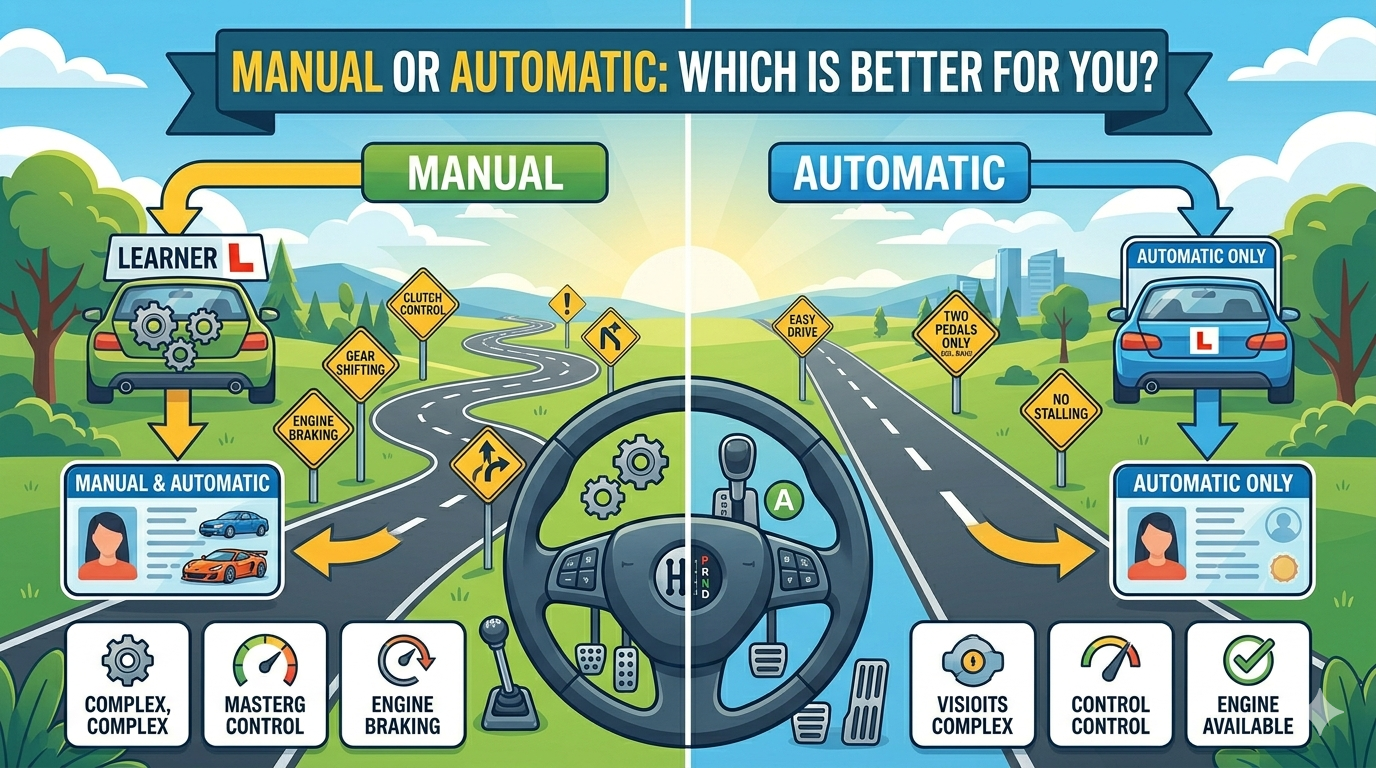
One of the first decisions you’ll make as a learner driver is whether to take your lessons in a manual or automatic car. It might seem like a small choice, but it can have a significant impact on how quickly you progress, how much you spend, and what you can drive once you’ve passed.
Here’s everything you need to know to make the right decision for you.
What’s the Difference Between Manual and Automatic?
A manual car requires you to operate the clutch pedal and change gears yourself using the gear stick. An automatic car does this for you — there’s no clutch pedal, and the car selects the appropriate gear automatically as you accelerate or decelerate.
In the UK, the vast majority of cars on the road are manual. However, automatic vehicles are growing in popularity, particularly with the rise of electric cars — which are all technically automatic.
The Case for Learning in a Manual
Greater licence flexibility
Pass in a manual and you can drive both manual and automatic cars. This is the biggest practical advantage — your licence gives you complete freedom on the road.
More choice of vehicles
The used car market in the UK is still dominated by manual vehicles, especially at lower price points. If you learn manual, you’ll have far more options when buying your first car.
Transferable skills
Learning to manage the clutch, anticipate gear changes, and read the road builds excellent driving intuition. Many instructors believe manual training produces more attentive, skilled drivers overall.
More widely accepted for company cars and hire cars
If you plan to drive a company car or hire a vehicle abroad, many will be manual. An automatic-only licence can restrict you in these situations.
The Case for Learning in an Automatic
Easier to learn — especially in urban areas
Without a clutch to manage, automatic lessons are generally considered less technically demanding. This makes them particularly well-suited to learners in busy city environments like Birmingham, where stop-start traffic can make clutch control stressful.
Can lead to a quicker pass
Because you have one fewer set of skills to master, some learners find they progress faster in an automatic. This can mean fewer lessons overall — which may offset any price difference.
Ideal for drivers with certain medical conditions or disabilities
If you have a condition affecting your legs, feet, or coordination, an automatic removes the need to manage a clutch, making driving far more accessible.
Future-proofing for electric vehicles
As the UK transitions away from petrol and diesel vehicles towards 2035, electric cars — which are all automatic — will become increasingly common. Learning automatic now means you’re already prepared for the future of motoring.
Less stressful for anxious learners
Nerves and clutch control are not a great combination. For learners who suffer from high anxiety behind the wheel, removing the clutch from the equation can make a meaningful difference to confidence.
The Automatic Licence Restriction — What You Need to Know
If you pass your driving test in an automatic car, your licence will carry a restriction — you are only legally permitted to drive automatic vehicles. To drive a manual, you would need to take a separate test in a manual car.
If you pass in a manual, there is no restriction — you can drive both types freely.
How Much Do Automatic Lessons Cost in the UK?
Automatic driving lessons typically cost slightly more than manual lessons — on average £3 to £5 per hour more, depending on the area and instructor. However, if you need fewer lessons overall, the total cost may be comparable or even lower. It really depends on the individual learner.
Manual vs Automatic: Quick Comparison
| Manual | Automatic | |
|---|---|---|
| Licence after passing | Drive manual & automatic | Automatic only |
| Difficulty | More to learn | Simpler to operate |
| Cost per lesson | Slightly cheaper | Slightly more expensive |
| Lessons needed | May need more | May need fewer |
| Best for | Maximum flexibility, rural drivers, used car buyers | City drivers, anxious learners, EV-focused learners |
So, Which Should You Choose?
Choose manual if you want the most flexibility from your licence, you’re planning to buy a used petrol or diesel car, or you enjoy learning all aspects of driving.
Choose automatic if you’re in a busy city like Birmingham, you’ve struggled with clutch control, you have a physical condition that makes manual difficult, or you simply want to pass as stress-free as possible.
Either way, what matters most is that you learn with a qualified, patient instructor who understands your needs and helps you build genuine road confidence.
Not Sure Which Is Right for You? Talk to Finesse Driving School
At Finesse Driving School, we offer both manual and automatic driving lessons across Birmingham. Our friendly team is happy to discuss your situation and help you decide which option suits you best — with no pressure and no hard sell. Get in touch today or book a taster lesson.